 lazyeye
Fields of Mistria is, among many things, a very large video game. With a plethora of ways to play and twelve different characters to date and marry, there’s an endless number of states for the game to find itself in. Players can decorate their houses however they like, dress however they please, and spend their days in whatever way they see fit. We also launched in early access two years before 1.0, with a promise to always keep save files compatible. And we support eight languages. And there’s only 15 of us. Oh, and we switched from GameMaker Studio 2 to an in-house engine a couple of months before 1.0.
Because numbers are fun, let’s break some down to put the project we’re covering in context.
lines of GML (gameplay scripts)
lines of Rust (engine, VM)[1]
bugs fixed
pull requests
years of development
team members, at peak[2]
executions of the test suite
engine swaps
Bugs come in all flavors and sizes, but the following are three particularly hard-to-spot ones loosely based on real incidents we’ve had. Try to think about how you’d ensure these never hit production.
An engineer renames a function that’s called 40 times in the game’s scripts. They update 39 of the calls, missing a single one that only triggers on 1 of the 100 possible floors in the mines.
A designer lowers the heart level needed to invite an NPC to the Shooting Star Festival from 5 to 4. We update the quest details, dialogue, and tutorials, but miss that the number is hard-coded in the logic instead of being read from our data files. Despite what the game tells them, players are unable to progress their quest.
The Tomato Soup item has a typo in its internal ID: tomato_soupp. We fix the typo and update every reference to it in the codebase. A player has this item sitting on the ground on their farm, and after updating, their game crashes when they load their save.
Relative to the size of the game, these bugs are all hidden in small corners. When we’re releasing a new content update, or turning around a quick patch to fix a bug, there’s only so much time to verify our fixes and check for regressions. We’re a small indie team with over a million players. So what do we do?
Unit tests are invaluable in software development, but they don’t translate to video games the way you’d hope. Don’t get me wrong, I love a good unit test – one of my other projects has over 2,200 of them – but a game’s bugs don’t live inside its individual systems. They live where those systems cross paths, in the endless combinations of player-driven content.
We don’t (only) need to assert the output of particular functions. We need to blast the real game through as many scenarios as possible and detect if anything is off.
Enter TestSuite.gml
There’s a variety of approaches to this problem, ranging from technical practices to production pipelines, but the one we’re covering today is our test suite. On our previous engine, the full set of tests could take up to seven hours to complete, so we had to run most of them in overnight cron jobs. On our new engine, we can run them headless with an uncapped time step. Split across 30 jobs, the entire thing typically finishes in under 10 minutes.
Goals
For the test suite to do its job, a few things need to be true about it.
- It’s quick to work with. Any engineer should be able to add a new test, or diagnose a failing one, without fuss.
- It’s authentic, without constant upkeep. It should test the game as realistically as possible, and spurious failures should be rare. No matter your policy, people start ignoring a suite once it has a reputation for crying wolf.
- It’s aligned with the codebase. The suite should fit the architecture of the project as a whole, so that its needs complement the needs of the code.
How tests work
Our tests are built on a core system in the codebase called Chains. If you’ve worked with coroutines, or asynchronous execution in general, the concept should feel familiar. A Chain is a series of Links, each carrying some logic and a condition for moving on. Every tick, the chain runs through its links until one tells it to wait, then picks back up from there on the following frame.
Fields of Mistria ships its scripts in plain text. I’ll be simplifying the excerpts in this article to keep things focused, but if you own the game, you can read the real code behind everything I talk about. It’s even possible to run the test suite on the shipped version of the game, but I’ll leave figuring out how to the talented modding community.
var chain = new_chain(); // a new Chain, which the engine will update each tick
chain.append(LinkId.Timer, 5); // this timer takes 5 ticks to finish
chain.append(LinkId.Function, function() {
    trace("hello!"); // once the timer above is done, this prints
});
chain.append(LinkId.Await, function() {
    return some_condition(); // fires every tick until it returns true
});LinkId.Timerwait 5 ticksLinkId.Functiontrace("hello!")LinkId.Awaituntil some_condition() is trueThe entire test suite is one very long chain. As the suite is assembled, each test is handed that chain and is free to append its own links.
// Add a new test called `dungeons`, which starts a new run in the mines and
// goes through every single floor for one frame each, to make sure they can
// all load without error.
TS_TESTS.push({
    name: "dungeons",
    call: function(chain) {
        chain.append(LinkId.Function, function() {
            randomize();
            trace("Starting a dungeon run with random seed {}", random_get_seed());
            enter_dungeon(0, DUNGEON_FLOOR_COUNT);
        });

        chain.append(LinkId.Await, function() {
            return is_dungeon_room(room); // wait to actually enter the dungeon
        });

        repeat DUNGEON_FLOOR_COUNT {
            chain.append(LinkId.Function, DUNGEON_RUNNER.proceed);
            chain.append(LinkId.Timer, 1); // room swap occurs between frames
        }
    }
});
Note that there are no manual asserts or checks here. Again, the primary goal of the suite is just to find crashes. It is not a replacement for real, human QA. We do write manual asserts at times, but later on we’ll cover how we program our codebase to work naturally with this kind of testing.
Our missed rename has been caught. As soon as the engineer opens a PR, the suite runs, visits every floor, and crashes on the undefined call. Merging is blocked until it’s fixed and the tests pass.
Testing story content
Fields of Mistria has over 150 cutscenes. Players advance through dialogue at their own pace, but at an average one, watching them all would take roughly 15 hours. They’re also highly specific, as there are twelve different characters you can date. Whether you’re going to watch the shooting stars with your crush, asking them to dance at the Harvest Festival, or attending your wedding ceremony, the scenes and dialogue are different for each of them. It’s incredibly easy to introduce a bug in one scene with a seemingly innocuous edit somewhere else.
But crashes aren’t the only thing we need to worry about; softlocks are their own nightmare. In many cases it’d almost be better if they were crashes. A crash gets reported to Sentry[3] instantly with information about exactly where it happened and precisely how many players it’s affecting. With a softlock, the player is just as stuck, but we have to wait on their reports and reproduction steps to diagnose it.
So our story tests serve two purposes. First, find any crashes hiding in the many cutscenes. Second, make sure all of the content is accessible exactly when we expect it to be.
// Test going to the Shooting Star Festival with Juniper. Elsie should visit us
// in the morning and give us the Brooch item, and then as long as we have at
// least 4 hearts with Juniper, we should be able to invite her. At 8pm we can
// go with her, and the scene should end the day.
SE.skip_to_date("summer 28");
SE.next(function() {
    // this is 4!
    var hearts_needed = todays_festival().date.minimum_hearts_required;
    NPCS[NpcId.Juniper].set_heart_level(hearts_needed);
});
SE.goto_scene_trigger("shooting_star_morning"); // Elsie visits us in the morning
SE.play_out_scene("shooting_star_morning"); // let the cutscene play
SE.goto(NpcId.Juniper); // teleport to Juniper

// If Elsie correctly gave us the Brooch item, it'll be in our hands, and the
// "invite" interaction should be available with Juniper since she's at the
// minimum 4 heart level.
SE.interact_with(obj_juniper, "misc_local/interact_invite");
SE.play_out_textbox(); // she says yes
SE.clock_jump("8:00pm"); // jump ahead to 8pm, when the festival starts
SE.goto(NpcId.Juniper); // teleport to her again

// If we succeeded in inviting her, we should be able to go to the festival
// with her now that it's past 8pm.
SE.interact_with(obj_juniper, "misc_local/go_to_festival");
SE.next(function() {
    // That interaction spawns the confirmation popup, so find it and tap the
    // "yes" button
    ANCHOR.tap_node(ANCHOR.get_menu(Menu.Popup).buttons.get(1));
});
SE.play_out_scene("shooting_star_juniper"); // Juniper's scene should be playing
SE.play_out_eod(); // the scene ends the day, so play out the end of day screen
SE is short for StoryExecutor, a set of tools for simulating gameplay authentically (within reason). We don’t just call the internal code we’re trying to exercise; we go through it from as high a level as we can, so we catch any issue the player could run into. For example, here’s what SE.end_day() looks like:
function end_day(scene_to_expect) {
    // seeks out where the player's bed is in the world and moves us there
    self.goto("bed");
    self.next(function() {
        // Now we look for the actual bed in the room and interact with it. If
        // that works the way we expect, a popup confirming our choice should
        // have spawned. We then press the same "yes" button the player would.
        with obj_node_renderer {
            if self.node.prototype.bed_kind != undefined {
                interact(node);
                ANCHOR.tap_node(ANCHOR.get_menu(Menu.Popup).buttons.get(1));
            }
        }
    });

    // the sleep sequence is a mini cutscene, so we wait until it's done...
    self.play_out_scene("sleep");

    // ...then, if we expect a cutscene to play this evening, we have to say
    // so and play it out
    if scene_to_expect != undefined {
        self.play_out_scene(scene_to_expect);
    }

    // finally, we make sure we're on the end of day screen and hit the
    // "next day" button
    self.play_out_eod();
}
Each of these commands doesn’t just perform the action it describes; it also crashes if the game isn’t in exactly the state that action implies. If we tell it to play out a scene and that scene isn’t playing, we crash. If we tell it to do something to progress a quest and that quest isn’t active, we crash.
Our hard-coded value has been caught. The test raises Juniper to the 4 hearts our data files ask for, but the logic is still secretly checking for 5, so the invite never becomes available. SE.interact_with fails to interact with her, and the suite crashes.
Catching broken save files
Corrupting a player’s save file is the cardinal sin for a game developer. A crash is annoying, sure, but it can be fixed in a later patch. If you break a save file in a way you can’t detect or fix with a patch, the player has lost every second of gameplay they’ve invested so far. Thankfully, we haven’t had to deal with this, in large part because of our test suite.[4]
Our project contains a folder called upgrade_targets full of save files, which come in two kinds:
One for every save-related bug we’ve ever had. They keep those bugs from coming back, and they’re a good excuse to add more test candidates to the suite.
Every time we release a new version, a tool generates a save that aims to contain every possible piece of content: every piece of furniture placed, every single item in some chest, every unlockable present, and so on.
We’re pretty consistent about adding patches whenever we PR an edit that affects saves, but this makes sure no mistake slips past. Every one of these saves gets loaded, and a basic set of tests is run over it to make sure nothing is corrupted.
Soup crash caught! Deleting that single p will cause, at the very least, the most recent stuffed save to crash as we try to deserialize whichever chest we shoved the soup into.
This is how we’ve been able to guarantee that a player’s save file will always upgrade, all the way back to our initial demo over two years ago.
Writing code aligned with the suite
Since the suite ultimately relies on crashes to detect errors, we take a very crash-forward approach to programming. Granted, many of our checks are debug-only asserts: in production builds we just emit a warning and continue, but in dev builds the game panics the moment anything seems out of place. I wrote about this approach years ago, and while that article is pretty old at this point, essentially everything in it still carries over to how we work today.
We also write our systems such that they demand testing. For example, every quest is required to specify which test it expects to be completed in. When that test finishes, it looks at every quest that references it, and if any of them aren’t in the player’s completed quest log, the test fails. The same goes for other systems, like cutscenes and menus.
When a writer adds a new cutscene to the game, we could ask them to always remember to get an engineer to update the tests, but it’s far safer to expect the game to take care of itself. Every cutscene has to declare which test is responsible for it:
[my_new_cutscene]
    # <...>
    # every cutscene must provide this field, otherwise we crash on launch
    test_target = "story_scenes"
If that test finishes without having played the new cutscene, the suite fails on the writer’s PR with a clear error. It’s less a failure than a useful reminder:
Test Suite Result: FAILED. The following cutscenes were not covered: my_new_cutscene.The results
After tens of thousands of suite runs, I can’t really begin to estimate how much time and money this system has saved us. Honestly, it’s hard to imagine the game being possible without it. When we decided to switch to our own engine built in Rust (which our Lead Programmer, Jack Spira, covers in his RustConf talk, Oxidizing Fields of Mistria), the test suite was the litmus test for whether it was ready for production. Short of shipping it, there was no bigger hurdle we could put in front of the new engine than getting through that enormous amount of execution. For months of its development, the suite doubled as a production tool, showing us exactly what was left to port over.
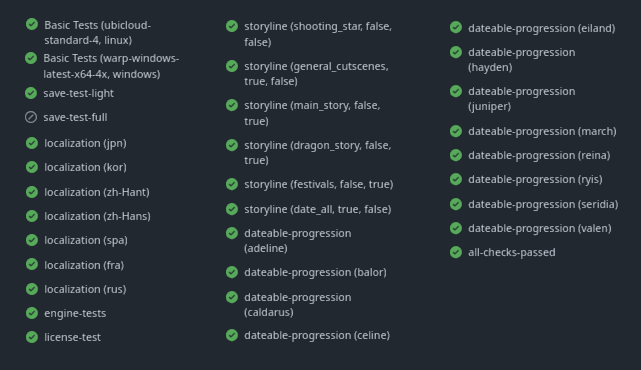
Plus, after your game has been in production for over seven years, it’s enormously reassuring to be able to look at this screen before hitting the big green release button on Steam.
-
Rust projects are obviously built on the shoulders of countless lines of open source code, so this number is approximated from the Rust inside of our engine, fabricator (our GameMaker runtime), and the Rust within Fields of Mistria itself. ↩
-
It’s tough to measure a number like this due to a mix of full-time and part-time roles, people joining and leaving, and the external teams we worked with for things such as QA and localization. You can refer to our MobyGames page for the full credits of all the incredible folks who made the game possible. ↩
-
Sentry and error reporting deserve their own article, but needless to say, automatic crash reporting is essential. This isn’t news to the software space, but many indie devs skip this. Don’t! ↩
-
Okay, this isn’t strictly true – it does happen to players who use mods and then open their saves on a new version without those mods installed. We’ve gotten much better over time at handling those errors so that they can still make it into the game. Ultimately, all I can really claim is that this has never happened at scale. ↩